MyPlace
One platform to find, create and track Afdas training courses, designed for five roles with opposite needs.
- Client
- Afdas, skills operator
- Role
- Product Designer, sole designer
- Timeline
- Ongoing
- Deliverables
- LMS, back office, design system
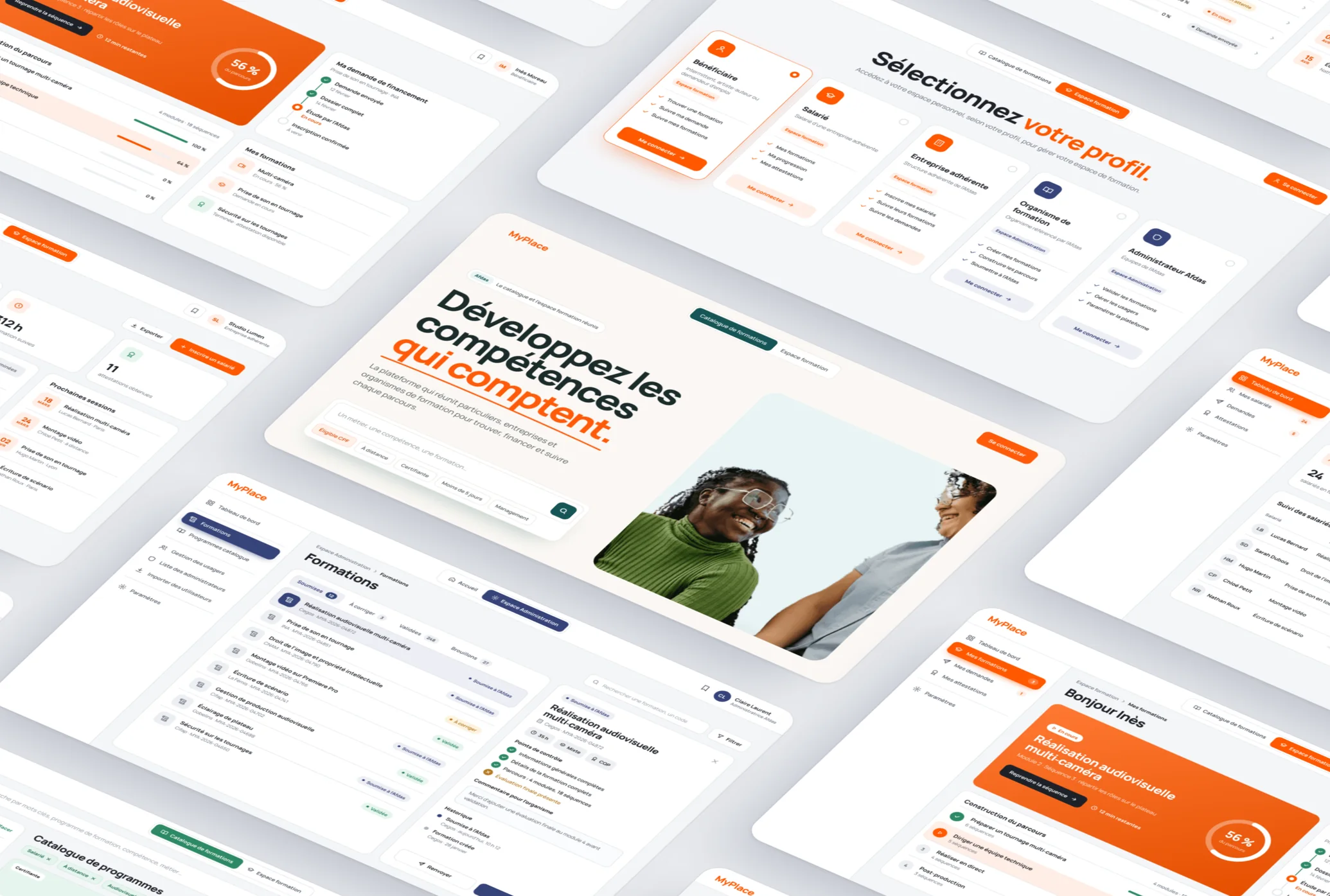
Five roles that depend on each other, and scattered tools that kept them from moving forward.
Map the dependencies, then give each role its own space on a shared foundation.
A unified platform now in development, 52 screens designed and a shared design system.
A fragmented training ecosystem.
Afdas funds training for the culture, media and leisure sectors. To search, publish or track a course, every stakeholder went through several tools, without ever seeing where the others stood.
Five tools, no shared status
Catalog, requests by email, a publishing tool, tracking in spreadsheets, validation on the side.
One entry point, one space per role
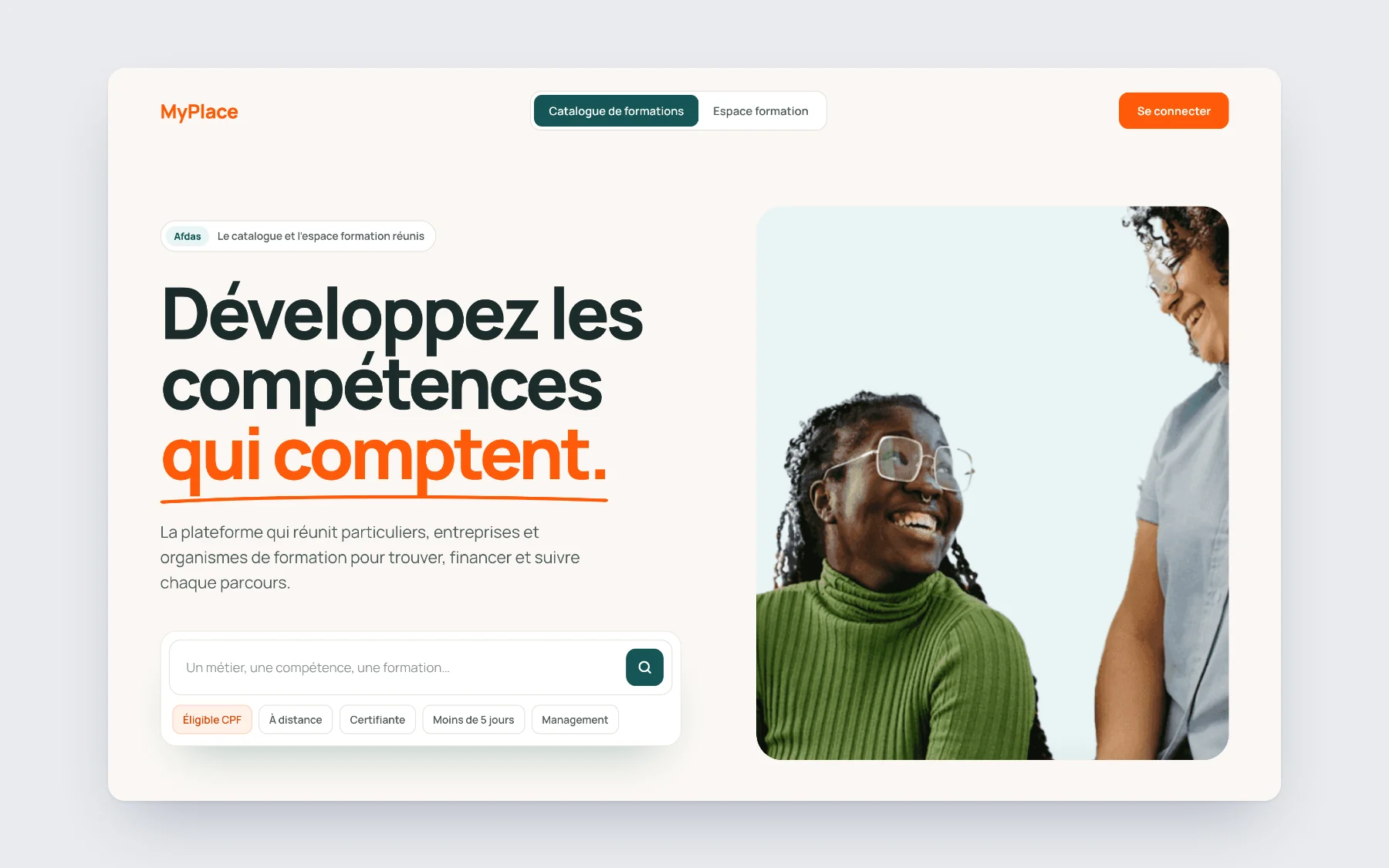
Catalog, learning space, dashboards and back office in the same product.
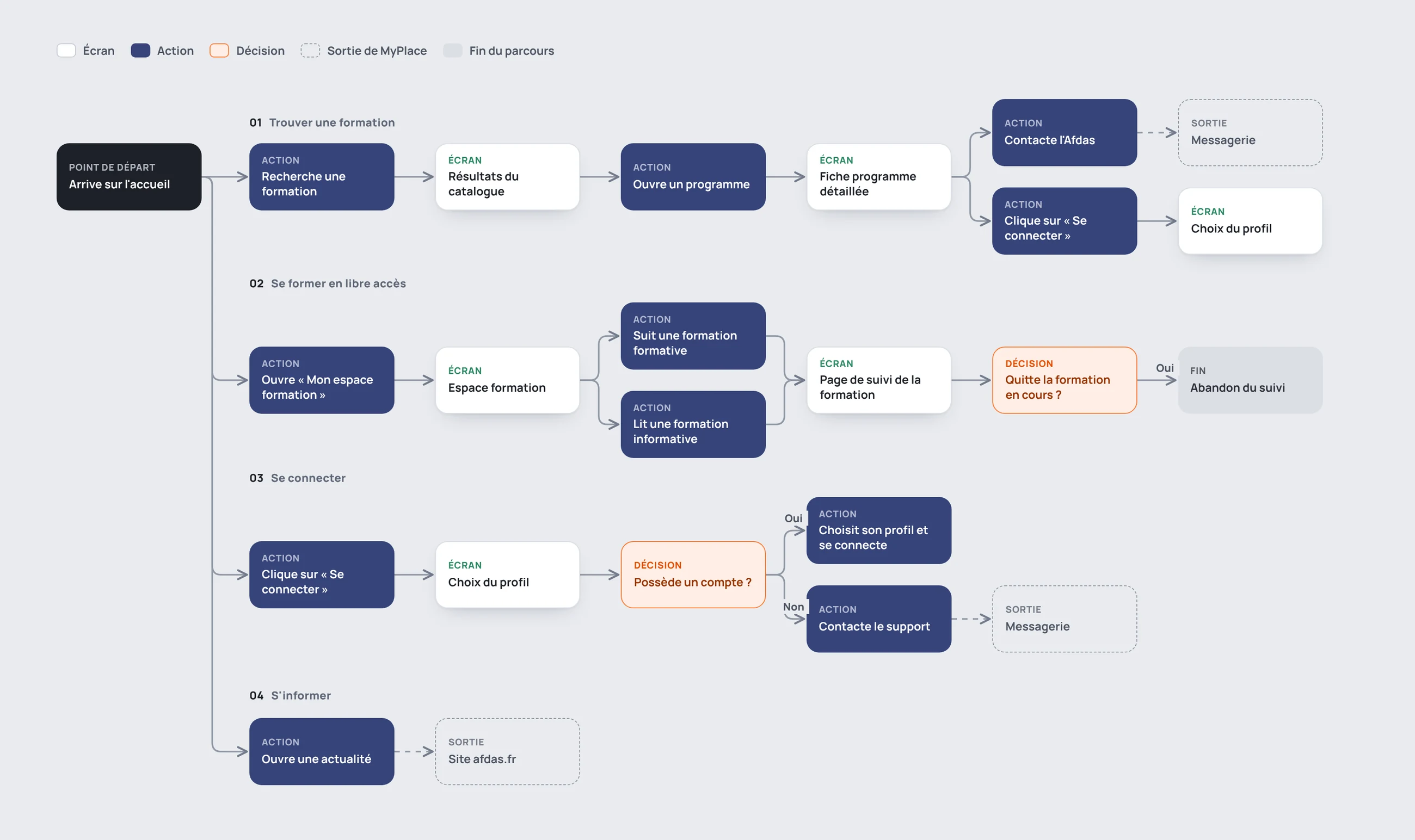
Five roles that depend on each other.
Training providers publish, Afdas validates, companies enroll their employees, learners and employees take the courses. Each has a goal, but none can move forward alone.
Find a course that fits their job, and get it funded.
Space: catalog and requests- A clear catalog with useful filters
- Understand what is covered
- Know where their request stands
Follow the course chosen with their company, at their own pace.
Space: learning space- Find all their courses in one place
- Pick up a module where they left off
- See their progress
Steer the upskilling of its employees.
Space: dashboard- See who is taking which course
- Track everyone's progress
- Know the status of each request
Create and publish courses without friction.
Space: back office- Enter a full course without getting lost
- Build modules, sequences and activities
- Create quizzes and assessments
Validate and oversee the training offer.
Space: administration- See what is awaiting validation
- Approve or send back with a comment
- Manage users and settings
Understanding who waits for whom.
Interviews, workshops with Afdas teams and a close read of the specs let me map the journeys and spot the blockers between roles.
user interviews
workshops with Afdas
journeys mapped
- CreateProvider
- ValidateAfdas admin
- PublishCatalog
- EnrollLearner, company
- TrackLearner, employee
The friction point: between creation and publication, nobody knew who had to act.
Five frictions, five principles.
A shared foundation, one space per role.
Each role only sees what concerns them. All share the same objects: course, module, sequence, activity.
Course page
Progress
Employee tracking
Course Builder
Assessments
Users
The trade-offs that matter.
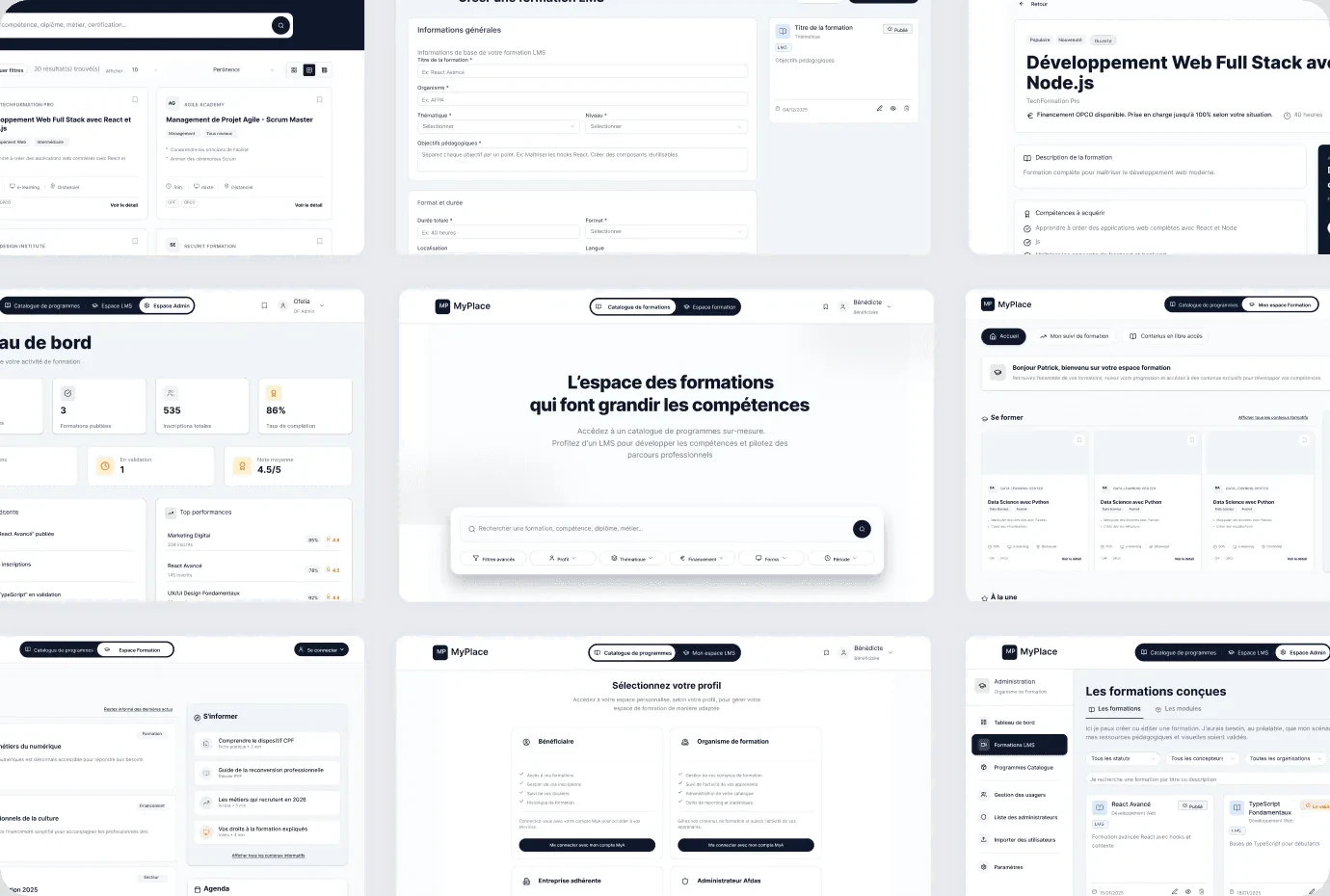
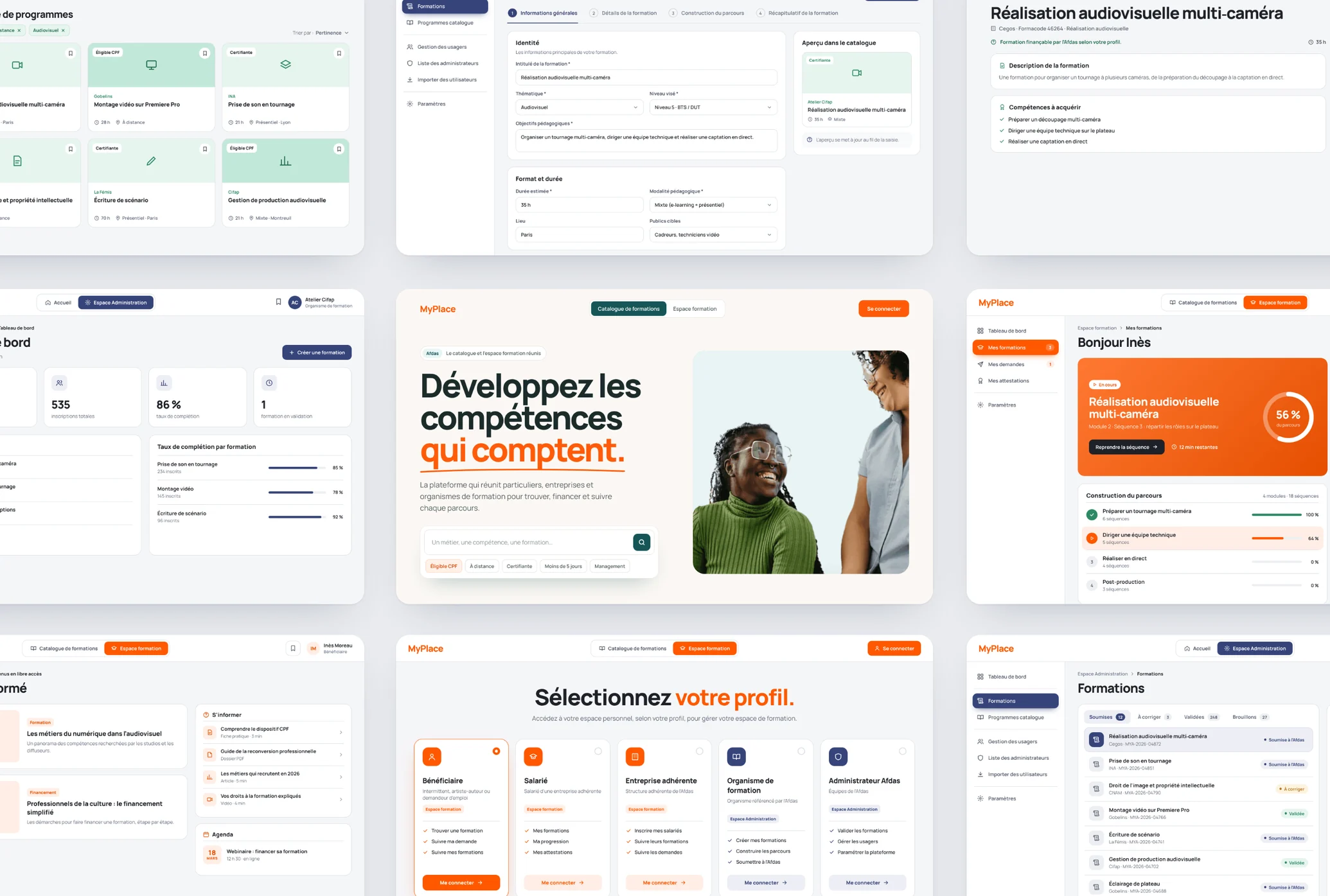
5 design decisions, and what settled them
For each decision: the chosen solution, the alternative ruled out, and the reason.
Editing a course in 4 steps
Autosave
Modules with 2 tabs
8 activity types
Images provided by Afdas
The product, space by space.
What the project delivered.
To measure after launch
The platform is in development: these are the metrics that will show whether the design delivers on its promises.
Time to publish
How long it takes a provider to create and publish a course.
Validation lead time
The time between submitting a course and Afdas approving it.
Online enrollments
The share of enrollments made directly from the catalog.
Support requests
Requests about a file's progress, caused by missing status visibility.
What I take away.
Specs guide the design
Checking every mockup against the requirements keeps you from adding what wasn't asked for.
Settle early with the client
Keeping a list of pending decisions unblocked sprints faster.
What I'd do again
Define success metrics with Afdas from the start, to measure impact from launch day.